From May through September, Lunch Hour Harvest brought agriculture, local food, and public health to the same table, one lunch hour at a time.
Our first recap covered the opening three sessions: an introduction to the intersection of agriculture and public health, soil health and nutrient density, and farmer mental health.
The final two sessions turned to climate resilience and community food access. Below, we look back at those conversations, then at what the full series added up to. Every session is recorded and free to listen.
Climate Resiliency & Agricultural Impact
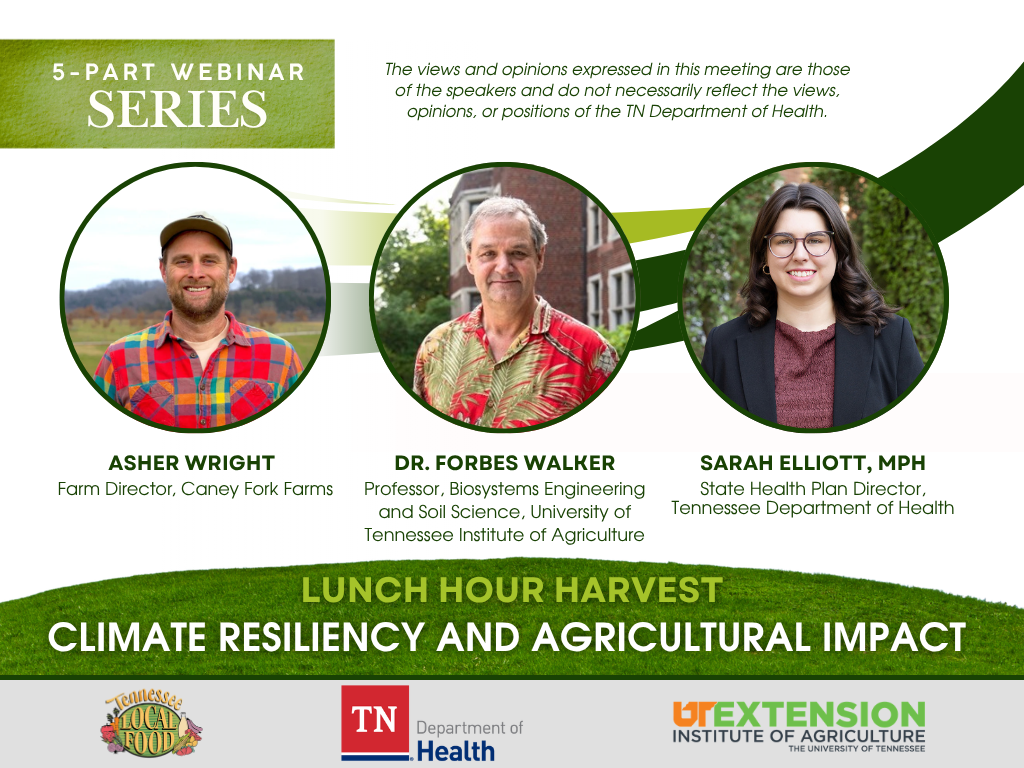
Panelists included:
Dr. Forbes Walker, UT Institute of Agriculture
Asher Wright, Caney Fork Farms
Sarah Elliott, MPH, Tennessee Department of Health
Session four asked what resilience looks like as droughts and floods both become more common. Asher Wright, farm director at Caney Fork Farms, made the case that it means more than bouncing back: it's the ability to plan ahead, and to ask whether the system you're running still serves you. Sarah Elliott framed it as a cycle, where the recovery after one event is the time to prepare for the next. Dr. Forbes Walker brought it back to the ground: everything in agriculture starts and ends with the soil. Tennessee is now primarily a no-till state, and cover crops such as deep-rooted warm-season grasses can soak up heavy rain and reach deeper moisture during a drought. The stakes reach past the farm gate. When farms go under, Sarah noted, farm-to-school programs and farmers markets lose growers, and rising temperatures and carbon dioxide are already lowering the nutrient density of crops.
Creative Community Food Access Solutions
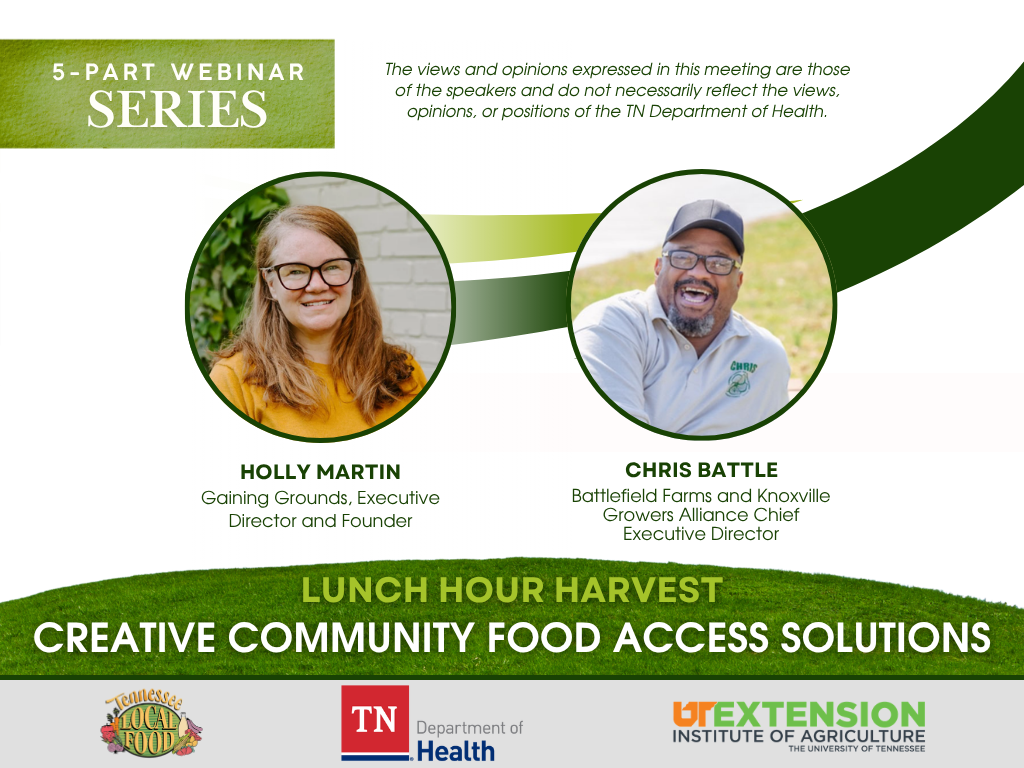
Panelists included:
Chris Battle, Battlefield Farm and Gardens
Holly Martin, Gaining Ground
Our final session opened with a definition and closed with a challenge. Pastor Chris Battle of Battlefield Farm and Gardens in Knoxville described food insecurity as a question of access, shaped by income, transportation, distance, and price. When his team bought seven items at a corner store near Battlefield, the total came to $20; the same items cost $7 at Food City, and several from the corner store were expired. That gap is the thinking behind the ONE FIVE, the grocery store Battlefield is working to open, where everything will sell for a nickel over cost. Holly Martin, founder of Gaining Ground in Chattanooga, showed what a community-rooted grocery can look like today: a 500-square-foot nonprofit store that sources about 90% of its produce from within roughly 200 miles, doubles SNAP dollars for fresh produce, and pairs food access with nutrition education. Both panelists landed in the same place. Communities already hold the answers, Chris said. And as Holly put it, the cavalry is not coming, so communities will have to invest in their own future.
What 5 Lunch Hours Added Up To
Across five sessions and 14 panelists, one idea kept surfacing: the health of Tennesseans is tied to how, where, and by whom our food is grown. It showed up in the soil, where nutrient density begins. It showed up in the strain farmers carry from weather, prices, and input costs they can't control. And it showed up in neighborhoods where the barrier to good food is cost and access, not desire.
The answers our panelists offered had something in common, too: connection. What helps farmers under strain is a strong network of people around them. Investing in farmers is investing in public health, as Sarah Elliott put it. And communities in Knoxville and Chattanooga are building their own answers to food access, one store and one neighbor at a time.
That's why this work matters. Tennessee once fed itself. It will again.
Thank You!
Thank you to the Tennessee Department of Health, and especially Paige Summers, for partnering with us on this series, hosting registration through TRAIN, and providing continuing education credits. Thank you to the UT Institute of Agriculture, and especially Dr. Kim Morgan, for helping secure presenters and making this series possible.
Thank you to our panelists for sharing their time and expertise:
Femeika Elliott, Rooted East Knoxville
Dr. Dawn Ford, Tennessee Public Health Association
Dr. Kim Morgan, UT Institute of Agriculture
Dr. Arvazena Clardy, Tennessee State University
Katharine Ray, The Heimerdinger Foundation
Kelsey Davis, Blooming Acres Farm and Tennessee Department of Environment & Conservation
Dr. Chaney Mosley, Middle Tennessee State University
Andy Lawrence, Tennessee Department of Mental Health & Substance Abuse Services
Dr. Emily Paskewitz, University of Tennessee
Dr. Forbes Walker, UT Institute of Agriculture
Asher Wright, Caney Fork Farms
Sarah Elliott, MPH, Tennessee Department of Health
Chris Battle, Battlefield Farm and Gardens
Holly Martin, Gaining Ground
And thank you to everyone who spent a lunch hour with us!

Lunch Hour Harvest was presented in partnership with the Tennessee Department of Health and the UT Institute of Agriculture. Views expressed by speakers do not necessarily reflect the positions of the Tennessee Department of Health.
CPH Recertification Credits: This program was approved for Certified in Public Health (CPH) continuing education credits by the Tennessee Department of Health, an approved provider by the National Board of Public Health Examiners. Up to 1 CPH Recertification Credit may be earned at this event. To receive recertification credit, log this activity in CPH Central: https://www.nbphe.org/stay-certified/.
NCHEC CECH for CHES/MCHES: Sponsored by Tennessee Department of Health, a designated provider of continuing education contact hours (CECH) in health education by the National Commission for Health Education Credentialing, Inc. This program is designated for Certified Health Education Specialists (CHES®) and/or Master Certified Health Education Specialists (MCHES®) to receive up to 1 total Category I contact education contact hours. Maximum advanced-level continuing education contact hours available are 0. Continuing Competency credits available are 0.
